“We have the first snowflake. Now let’s build a blizzard.”
Hi — I’m Zhengqian Jin, a Ph.D. candidate in Electronic Science and Technology, specialising in Energy Storage Science and Engineering at Xi’an Jiaotong University.
My research centres on advanced battery electrochemistry and catalytic interphases — lithium metal anodes, anode-free configurations, and high-entropy catalytic materials for next-generation energy storage.
Education & Position
Ph.D. Candidate, Electronic Science & Technology
Xi’an Jiaotong University, Xi’an, China National Innovation Platform (Center) for Industry–Education Integration of Energy Storage Technology
Scientific visualisation and figure design. Spanish, slowly. Football, boxing, and the NFL, mostly as a spectator. Long-distance running, mostly not.
@EKL_Batteries
Alongside the papers I run @EKL_Batteries, a PaperBot that pulls new battery and materials work off RSS, filters it in Python, and posts what survives. It is also, roughly, my own reading surface.
Tools
I build small utilities when a workflow annoys me twice. They live on the Toolkit page — a Markdown-native publishing helper, a few plotting and literature-processing scripts, and whatever else has proved worth keeping.
Selected Visualisations
Figures I designed and drew for recent papers, newest first. Scientific visualisation is a standing interest of mine, not a byproduct of writing them up — these are the ones I keep coming back to. Click any figure to enlarge.
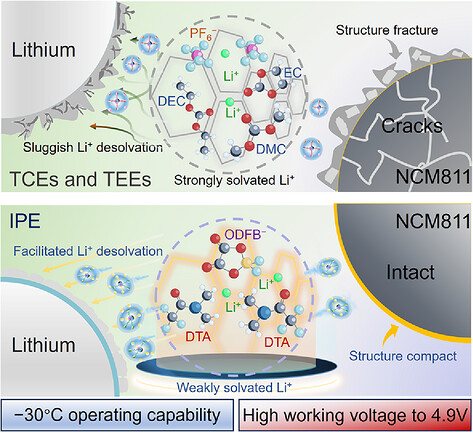
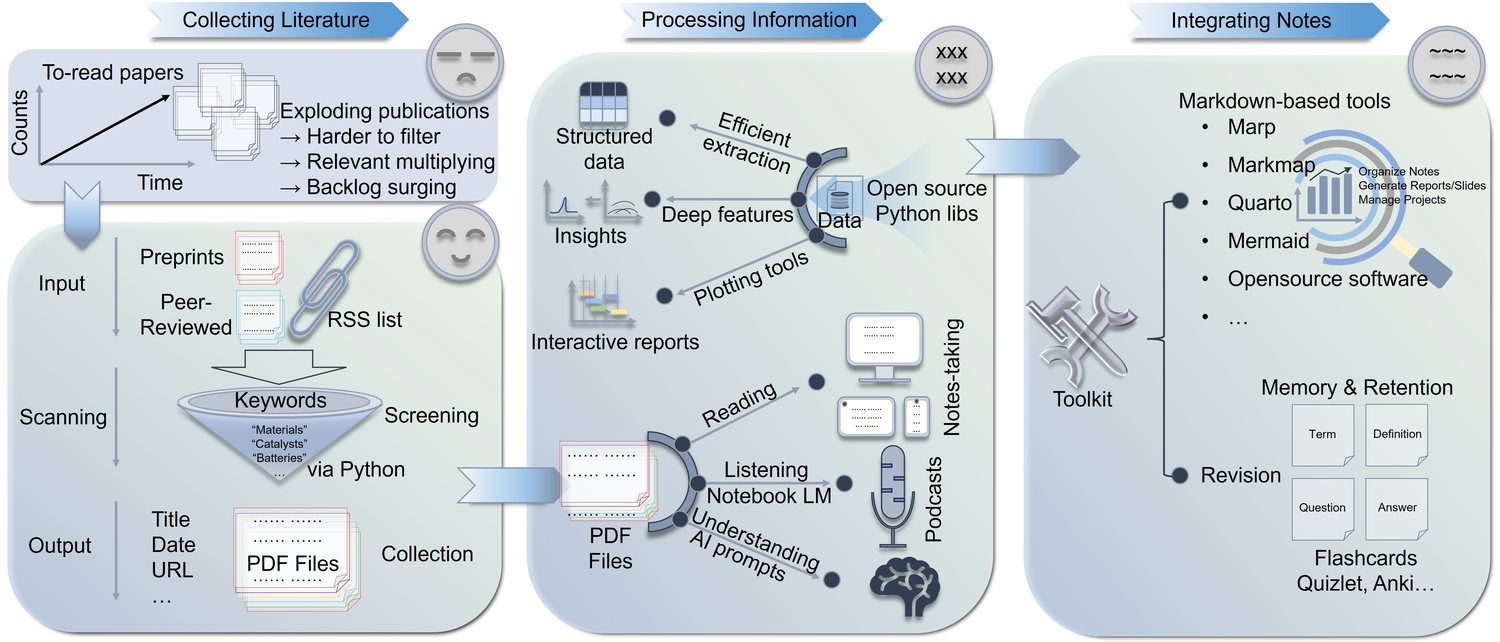
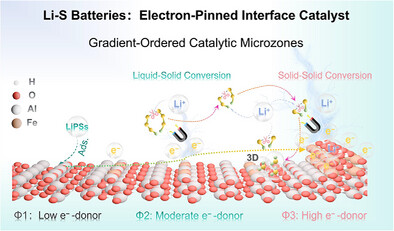
Intramolecular polarisation reshapes the solvation shell so that Li+ desolvates readily at −30 °C while the NCM811 surface stays intact to 4.9 V — the weakly-solvated structure on the lower panel is the whole argument in one frame. Cao, Jin, Li et al., Advanced Materials (2026) 74260 Collecting, processing, integrating — the three-stage framework for digital research. Drawing the workflow out in full turned out to be the fastest way to find the places where it leaks. Z. Jin & K. Xi, Matter 9 (2026) 102777 Three catalytic microzones ordered by electron donation, Φ1 to Φ3, carrying the polysulfide through liquid–solid and then solid–solid conversion. The slow step of the Li–S cascade, usually drawn as a single arrow, gets three. L. Jin, Z. Jin, T. Deng et al., Advanced Materials (2026) e73517 Conventional layered double hydroxides against their high-entropy counterparts, side by side. Configurational entropy buys stability without giving up the tunability that made LDHs interesting in the first place. Jin et al., Nano-Micro Letters (2026), Fig. 1 How the composition space gets searched. The machine-learning loop on the right is doing what a decade of one-element-at-a-time substitution did on the left, which is the point of the figure. Jin et al., Nano-Micro Letters (2026), Fig. 2 Every reported OER overpotential in one bubble field, with element frequency underneath. Two plots that answer “what has actually been tried, and did it work?” without a table. Jin et al., Nano-Micro Letters (2026), Fig. 7 The synergy argument, extended past electrocatalysis into biomedicine. Same material class, very different failure criteria — worth drawing on one canvas. Jin et al., Nano-Micro Letters (2026), Fig. 12 The outlook panel. Review figures like this usually age badly; this one was drawn to be falsifiable, which is a different design brief. Jin et al., Nano-Micro Letters (2026), Fig. 13
Research
Lithium metal & anode-free cells
Plating/stripping behaviour on Cu current collectors, SEI formation, and the kinetics that separate a stable interphase from a dendritic one.
Interface catalysis & inhomogeneous reaction
Catalytic conversion in Li–S systems; high-entropy layered hydroxides as a tunable platform; enthalpy–entropy compensation in interfacial kinetics.
Distributed-parameter in situ / operando characterisation
Multi-scale readout of SEI and Li deposition, with an emphasis on protocols that other groups can actually reproduce.
Research infrastructure & data assetisation
Turning raw battery data into structured, citable assets — and studying the metadata layer that carries scholarship between machines.
Published In
Where the work has appeared so far — mark size roughly tracks how much of it landed there.